


In India, businesses often face the challenge of accurately classifying goods and services under the right tax codes, a task that requires precision to avoid costly errors. Incorrect use of SAC and HSN codes can lead to non-compliance, resulting in fines, penalties, or audit issues. However, by understanding the key differences between these codes, businesses can streamline their GST filing process and avoid operational disruptions.
This guide will provide you with essential insights into the SAC code, including the SAC full form and how it differs from the HSN code to help maintain compliance and improve the efficiency of your GST filing process.
What is the SAC Code in GST?
SAC stands for Services Accounting Code, which is used to classify services under the GST regime in India. The categorization of services plays a crucial role in ensuring that businesses and individuals can correctly identify the applicable GST rates for each service they provide.
The SAC Code is part of a broader initiative to standardize the taxation system for services in India. Just like the HSN Code applies to goods, the SAC Code serves the same purpose for services, making it an integral part of the GST framework. For businesses dealing with services, it is mandatory to know the SAC Code to ensure proper registration, invoicing, and returns under GST.
To better understand the significance of SAC Codes in GST, let’s explore how these codes are structured and how they play a vital role in the classification of services.
Structure and Identification of SAC Code
SAC Codes are structured to identify and classify services efficiently. These codes consist of six digits, with the first two digits always starting with 99. This structure helps to distinctly classify services under the GST system. Each service category or subcategory has a unique code, making it easier for both businesses and tax authorities to handle the details of service taxation.
For instance, SAC 995411 refers to general construction services of buildings. This numeric format ensures that every service type has a specific code, preventing confusion and errors in taxation. By understanding the structure of SAC Codes, businesses can avoid any ambiguities related to classification, ensuring that the right GST rates are applied for the services offered.
Need help with identifying SAC Codes for your services? Pazy can assist you in managing the process of selecting the correct SAC Codes to ensure smooth invoicing and compliance.
Now that we’ve explored how SAC Codes are structured, let’s take a closer look at their primary purpose and how they are applied to ensure smooth and accurate taxation under the GST system.
Purpose and Application of SAC Code
The primary purpose of the SAC Code is to allocate unique codes to services for accurate taxation. By categorizing services in this manner, it becomes easier to apply specific GST rates that are associated with each category of service.

The SAC Code system is useful for service providers and for businesses and government authorities to ensure compliance with GST. Invoices, GST returns, and even GST registrations require businesses to correctly mention the SAC Code corresponding to the services they offer. This is a crucial step in the GST compliance process, ensuring that businesses are not penalized for errors in tax reporting.
The application of SAC Codes also helps identify the applicable GST rate for each service, allowing businesses to determine the amount of tax they need to charge to their customers. Having understood the purpose and application of the SAC Code, let’s now explore the specific SAC groups and the range of services they cover under the GST framework.
SAC Groups for Various Services
According to the IndiaFilings Guide, the SAC system was developed by the service tax department to classify various services. Later, the GST Council adopted this system for imposing GST across the country. GST on services is applied in five different slabs: 0%, 5%, 12%, 18%, and 28%. Below are some commonly used SAC groups, along with their corresponding services:

Pazy can streamline the management of SAC Codes for your business, ensuring accurate classification, compliance, and smooth GST integration for efficient operations. Get started to learn more!
Now, let’s examine why these SAC Codes play an important role in ensuring tax compliance and transparency across sectors.
Importance of SAC Codes in GST Compliance and Taxation
SAC codes are used by businesses, government authorities, and tax professionals to identify the nature of services provided. Here’s why SAC codes are significant:

1. Tax Compliance and Clarity on Tax Rates
SAC codes play a crucial role in ensuring tax compliance under GST by classifying services accurately. The correct SAC code helps businesses determine the applicable tax rate for each service, simplifying the process of calculating and reporting GST. This ensures that services are taxed correctly, avoiding any errors in returns or tax payments.
2. Standardization
SAC codes provide a standardized way of categorizing services. This uniformity simplifies reporting, auditing, and documentation for businesses and tax authorities.
3. Filing GST Returns
SAC codes are required for filing GST returns. When businesses provide services, they must report the corresponding SAC code along with the value of the service and the GST charged, ensuring proper tax compliance.
4. Government Monitoring and Tracking
SAC codes enable the government to monitor the flow of services in the economy. This allows them to track the performance of various service sectors and make data-driven policy decisions.
5. Cross-Border Transactions
SAC codes are helpful in identifying services provided across borders, especially in the case of exports and imports of services, which may be subject to different tax treatments.
To ensure your business is fully compliant with SAC Code requirements, contact Pazy to learn how its automation can simplify tax reporting and service classification.
To better understand SAC codes’ role in GST compliance, it’s helpful to compare them with HSN codes for goods. Let’s explore this comparison, which highlights key differences, ensuring accurate classification and simplifying the GST filing process.
Understanding SAC and HSN Codes: Key Differences
While the SAC Code and HSN Code may appear similar, they serve distinct purposes in the taxation system. Here are the key differences:
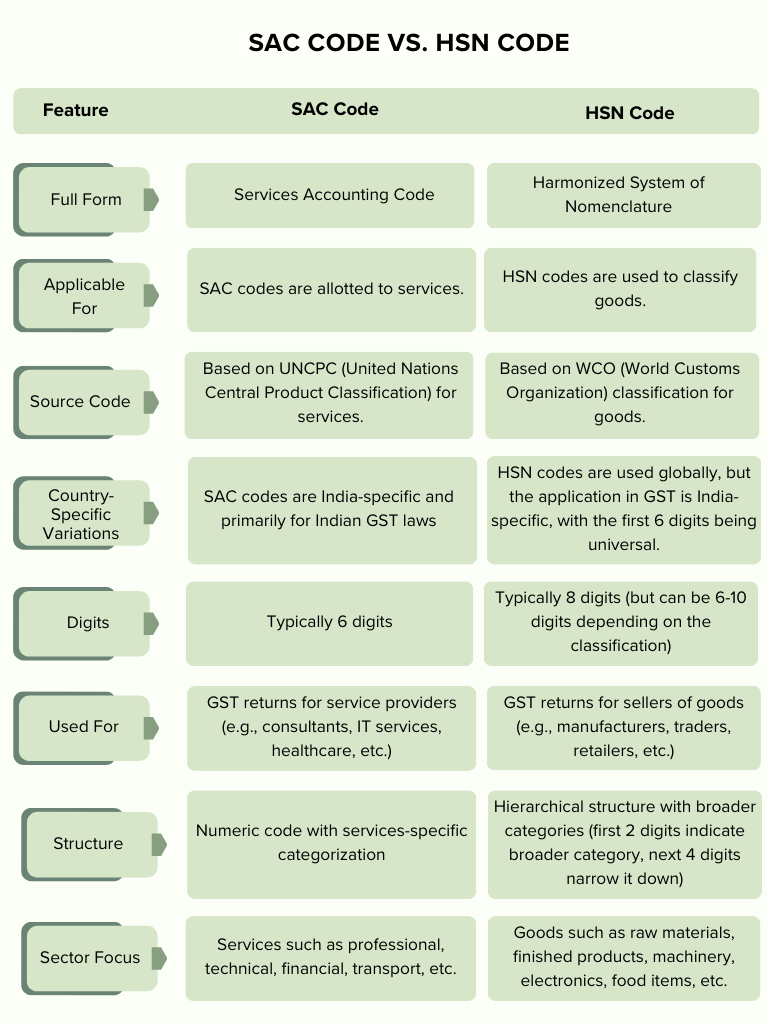
These distinctions help both businesses and tax authorities accurately classify and apply the correct GST rates to services and goods. To further clarify, let’s look at examples of SAC and HSN codes. The following table breaks down these codes into hierarchical categories, offering a detailed view of service and goods classification.
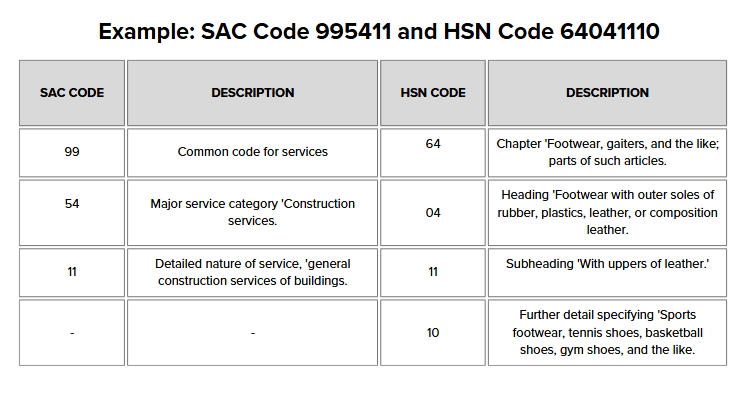
Understanding the distinctions between SAC and HSN codes can greatly simplify your GST compliance process. By ensuring accurate classification, businesses can avoid possible issues with tax filings.
To streamline your GST management further and ensure accuracy in your code classifications, let’s see how Pazy offers automated solutions to help you stay compliant and optimize your processes seamlessly.
Pazy: Simplifying SAC vs. HSN Codes for Your Business Success

Pazy is a comprehensive financial management platform that simplifies the challenges of SAC Code management. Our expert tools and guidance ensure accurate tax classification, seamless GST compliance, and efficient invoicing. With Pazy, businesses can easily manage these critical aspects, maintain transparency, and avoid costly penalties.
- Automated GST Reconciliation
Pazy’s automated GST reconciliation ensures that all transactions are matched accurately, eliminating manual errors and saving valuable time. It streamlines the entire process, making it faster and more efficient for businesses.
- Reduced Tax Leakage
By identifying discrepancies early in the process, Pazy helps businesses capture the full tax credit, minimizing tax leakage. Its automated system ensures that all eligible tax credits are accounted for, optimizing your financial operations.
- Real-Time Error Alerts
Pazy provides real-time alerts for any discrepancies or errors in your SAC and HSN code classifications, ensuring that issues are addressed promptly. This proactive approach reduces the risk of costly mistakes and ensures accurate GST filings.Pazy provides customized solutions to meet diverse business needs. It simplifies GST management for small to medium-sized businesses, automates reconciliation for finance teams, and ensures sector-specific compliance. For entrepreneurs and startups, Pazy offers cost-effective tools to streamline compliance and maintain tax accuracy.
Conclusion
The SAC Code plays a pivotal role in ensuring the smooth functioning of the GST system. It is essential for compliance, transparency, and accurate taxation for services, just as the HSN Code does for goods. Understanding SAC Code vs HSN Code can help businesses manage tax regulations more effectively.
Staying compliant with evolving GST regulations requires precision and up-to-date knowledge. Pazy simplifies tax classification, ensures accurate invoicing, and helps businesses navigate GST requirements effortlessly. With automated tools and expert guidance, Pazy enables organizations to maintain compliance while focusing on growth.
Ensure accurate tax classification, GST compliance, and seamless integration with Pazy’s efficient SAC Code management. Schedule a Free Demo today to get started.
FAQs
1. Can the SAC Code be changed after registration?
Once a SAC Code is assigned to a service during GST registration, it generally cannot be changed unless there’s a significant change in the nature of the service provided.
2. Is the SAC Code required for export services?
Yes, the SAC Code is required for export services to correctly categorize and apply applicable tax exemptions under GST.
3. Can SAC Codes be used for international trade?
No, SAC Codes are primarily used within India for GST purposes. International transactions typically use different classification systems like the Harmonized System.
4. What happens if a service provider uses the wrong SAC Code?
Using the wrong SAC Code can lead to incorrect tax filings, potential penalties, and delays in GST returns or refunds.
5. How do I find the SAC Code for my service?
SAC Codes can be found in the official GST portal or the GST Act, where services are categorized by industry or type.
6. Can SAC Codes help in determining tax rates?
Yes, the SAC Code helps in determining the applicable GST rate for a service, as it links the service to the relevant tax slab.
7. Is there a penalty for not using the correct SAC Code?
Yes, failing to use the correct SAC Code can result in penalties, as it leads to incorrect tax classification and improper GST filing.
8. Can SAC Code be used for mixed services?
For mixed services, service providers must use the SAC Code that best describes the predominant nature of the service.
9. Can I manually assign a SAC Code to my service?
No, SAC Codes are predefined by the GST authorities and must be selected based on the type of service you provide.10. Are SAC Codes applicable for both B2B and B2C transactions?
Yes, SAC Codes are applicable for both Business-to-Business (B2B) and Business-to-Consumer (B2C) transactions under GST.